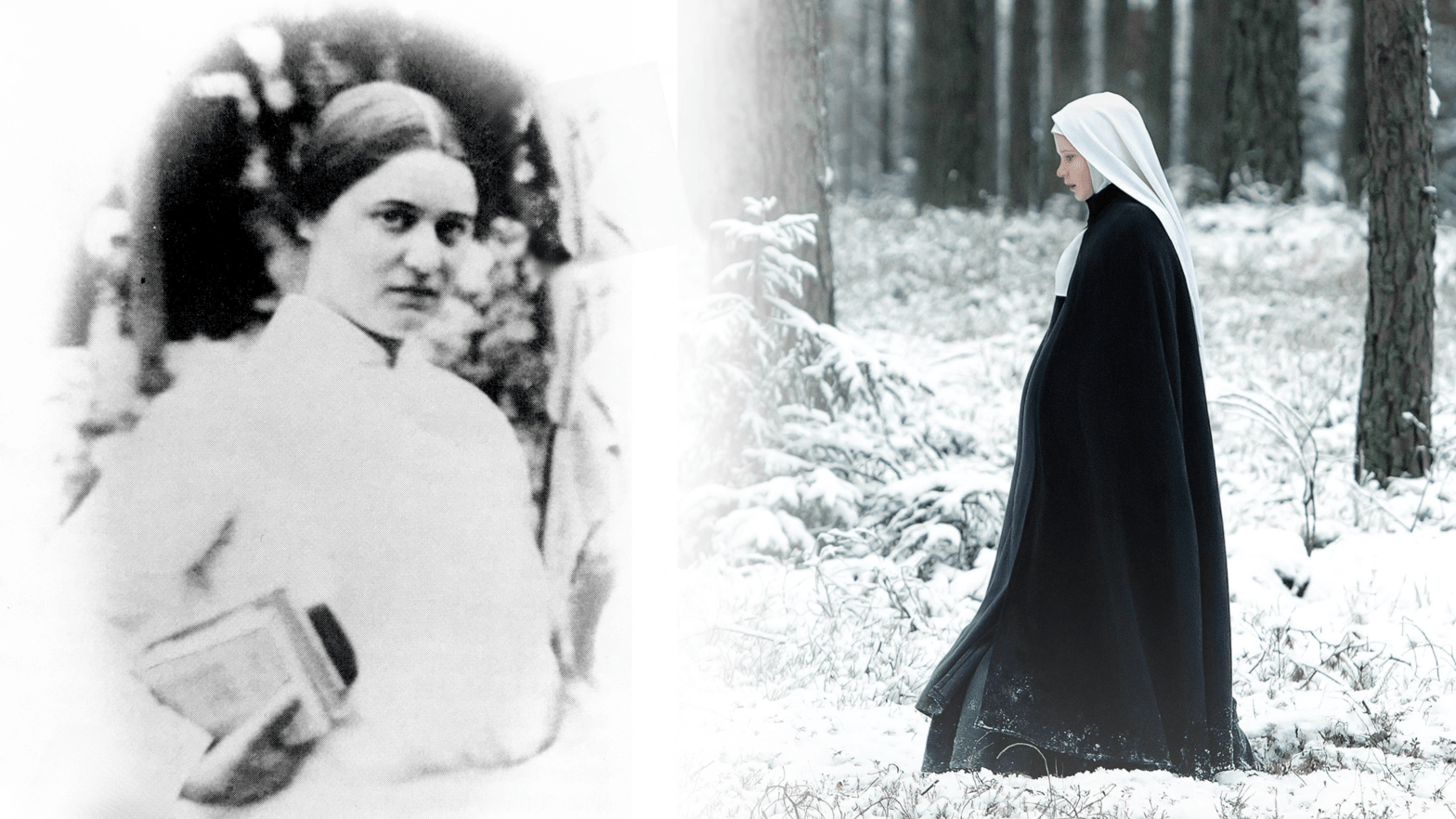
The Innocents (2016) joins the ranks
of challenging religious films
that can push you further from God,
or draw you closer to him.
Much like suffering itself.
Some years back, I became enamored with the work of a respected Jewish-atheist-philosopher-feminist turned Carmelite Catholic nun: Edith Stein, later known as St. Benedicta of the Cross. She remained a staunch feminist and held onto her Jewish identity, and brought her deep knowledge of experiential philosophy into the mystical tradition of the Carmelite order, writing volumes of work about the transformative power of suffering, prayer, and the spiritual life. In August of 1942, she was taken from a convent in the Netherlands and gassed at Auschwitz. She was later declared a saint and has been extremely influential in the development of theology and so much more.
Despite wavering in my faith this year, The Innocents made me return to the powerful work of Edith Stein. I feel hope again. It may seem ridiculous to outsiders, but it is possible to maintain your faith in God despite devastating tragedy. “Behind all joy lies the cross,” says Sister Maria, in a harrowing scene I will detail later. The cross is the most powerful symbol and meditation for suffering. Not even God escapes it.
In The Innocents, as is also recorded in this unfortunate era of history, cloistered Benedictine sisters have experienced tragedies almost worse than death. They have been repeatedly raped by Soviet soldiers and several have been impregnated. It is an unimaginable cruelty they have been subjected to. Due to strict, rigid, and frankly self-annihilating customs and teachings of the time, these pregnant nuns would likely be ostracized and their convent shut down, if their condition was discovered. So they live in shame and secrecy, with no knowledge or assistance to have their babies, and no plan for what to do with them when they arrive.
A desperate Sister Teresa, who cannot bear the sounds of her sisters screaming in agony, seeks out a doctor who will keep their secret safe. She meets a female French doctor, Mathilde, who also happens to be a communist, inspired by the real-life Madeleine Pauliac. Mathilde is a Godsend for these precious, traumatized women. Among many things, she saves them from further abuse by soldiers, even suffering assault herself due to the risks she takes for them. But the scrupulosity and shame of the sisters runs tragically deep, and Mathilde greatly struggles to offer actual medical attention to the sisters in need. Despite the agonizingly tragic last third of the film, the final scene offers us great hope about the future of the sisters and their babies.
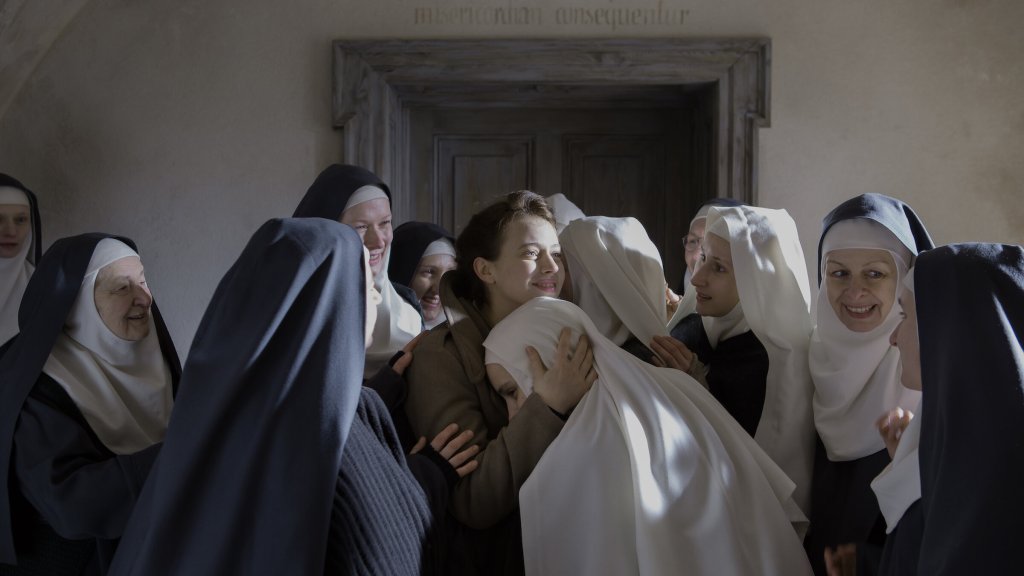
But, the scene that defines the film for me, as a Catholic, is as follows. Mathilde is speaking with Sister Maria, the most respected sister that quietly but courageously leads the others. Sister Maria confesses that she relives these tragic events every day. Mathilde sincerely asks how the sisters have not lost their faith. Sister Maria responds:
“You know, faith. At first, we’re like a child whose father holds his hand, who feels safe. A moment comes — and I think it always comes — where the father lets go. We’re lost, alone in the dark. We call, nobody answers. If we’re not ready, we’re surprised, and it hits us in the heart. That’s the cross. Behind all joy, there is the cross.”
The theology of the cross is this: there is no way to true joy except to embrace our own suffering. There can be no resistance to feel the grief, the hurt, the cross. The only way is through. Bitterness, nor resentment can be the goal. Some suffer intense external trials, some only interior trials, but the cross finds us all: the sense of abandonment, of doubt, of grief. We must feel it, without resistance. It is a purgation of sorts.
Jesus on the cross redeems suffering insofar as we now have a symbol of how to suffer. Even God experienced the abandonment, doubt, and grief. And due to this, our suffering (now called the cross) can now be bearable. Christ says, “My yoke is easy, and my burden is light,” which Stein reminds us of in her book, The Science of the Cross, left unfinished on her desk when she was taken by the Gestapo. With faith, hope, and a lack of resistance (the resistance built into our nature) our Cross can be light. In the sisters’ case, I believe it may have been unbearable otherwise.
The main problem is when people shame themselves or others when they simply aren’t there yet. It is not a sin! These books about the cross and suffering the “dark night of the soul,” are written mainly for those in monastic life, who undergo painful catharsis and purgation as a result of the detachment required in monastic life. They are faced directly with all of their psychological issues, attachments, and bare senses. It is a good thing for monks and nuns to be rigorously sifted through, to make sure healthy people get in. Because it’s incredibly hard. The disgusting sex abuse scandals, for example, are partly because of how many unsafe men are let into seminary.
Just because these realities are recorded for the instruction of monks and nuns doesn’t mean they aren’t real or true. Because of the intensity of monastic life (and writers like St John of the Cross, St Edith Stein, St Therese, and contemplatives in general) the hidden, mystifying realm of the of the psyche was being uncovered for us to see. Their writings demonstrate the psyche under great distress, with an orientation toward love rather than self destruction.
My point is that these figures present a concentrated, more intense model of the dark night of the soul. For most of us, though, the process is much less concentrated. It is a slower, lifelong process that requires great patience. For us on the outside, healing may happen more through relationships (like marriage or friendship) or through therapy. Therapy, provided by experts of the mind, greatly helps guide the process today. Yet faith in Christ undeniably helps this process, too, especially if you have a Carmelite or mystical framework. You don’t have to, it will just be harder without the hope, symbolism, and grace of the cross.
Finally, my heart breaks most for those who carry religious trauma and still desire God. They must undertake the painful work of unlearning the voices of the cruel leaders and distorted teachings that wrecked their minds and/or bodies. Teachings, for example, like the ones that make these innocents feel so ashamed.

 The Art of Hope