Warning: this film contains explicit content.
I’m not easily smitten by political cinema, as it is easy to use this powerful medium to manipulate the viewer’s emotions for political ends, especially in film. Thus, I do not have much interest in dissecting writer/director Michael Haneke’s admittedly powerful allusions to the rise of fascism and brutality in Germany, as I find them quite speculative. I am more interested in his general assessment of the origin of abuse and violence. I see these elements of the film as powerful means to tell a profound human story that recurs every few generations.
Present within these brilliant, somber frames is a story about the fragility of harmony, civility, and innocence, which wither like a dying flower when decay seeps into a single family or a village. It is a story as old as time; the kind of horror that fills history and fairytales alike.
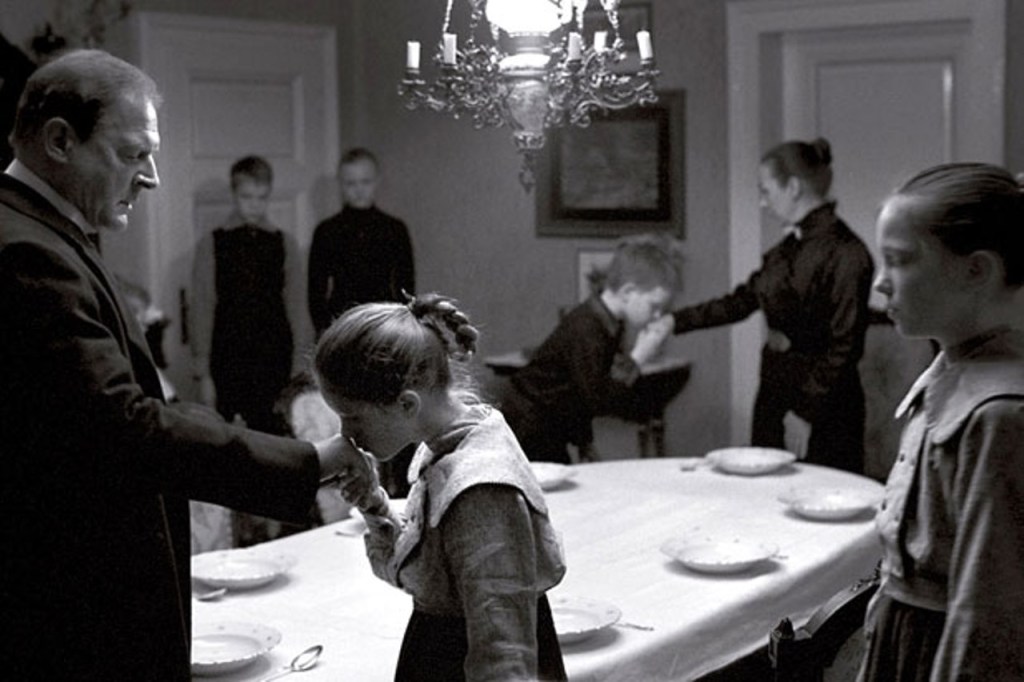
Haneke is very concerned with the treatment of children, whom he rightfully depicts as the heirs of the future generation, an important yet fading understanding of our younglings. In this way older children should be treated like adults, to prepare them for the world. Understanding this, the parents in this German village are excessively harsh toward their older kids, subjecting them to humiliation and brute force. But true treatment of children like adults is respecting their freedom after you’ve laid a just foundation for them. It is a tyrannical, Germanic Protestantism that Haneke is condemning here, as these manipulative practices stem from a lack of respect for the dignity of free will, something Protestantism (not all of Christianity) intrinsically struggles to comprehend with its stiff and cloistered worldview. Both decay and rebellion were inevitable. A child’s innocence cannot be forced, only guided, as children grow into adults and learn to navigate the sometimes-terrifying open waters of free will. This is the rule of God himself, who lets us wander so freely that we deny his very existence. He knows that love forced is not love at all.
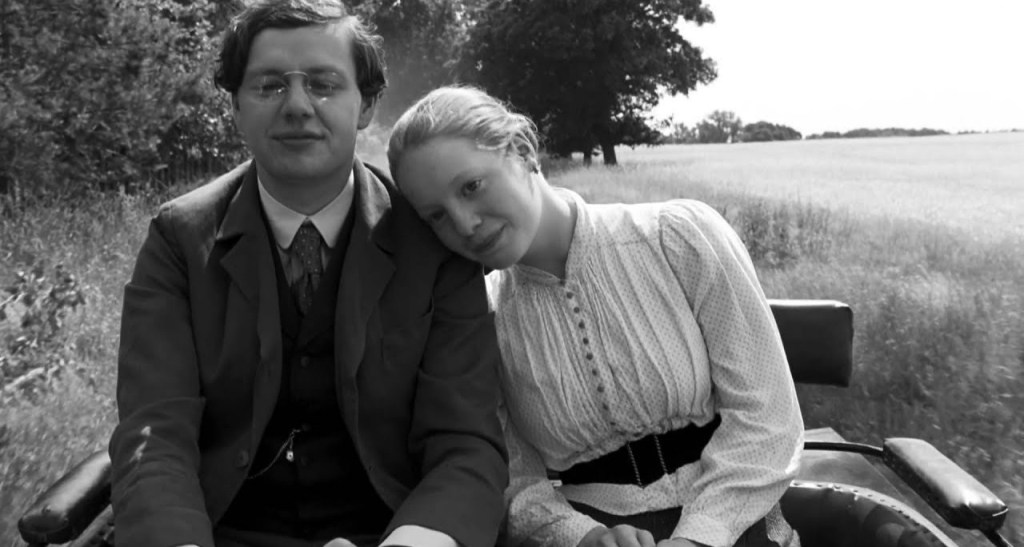
Amdist the hell and despair of The White Ribbon, there is an unpretentious, wholesome love story between two central characters, revealing the hope Haneke has for humans, and a faith in the power of love. It was a classy choice by Haneke, because the film would be undeniably dour otherwise. Many filmmakers, including himself, can become quite indulgent in showing us our evil, fearing it less profound to show us our goodness. The romance here is sweet, chivalrous, and pure: the story of a true gentleman and a lady, bringing light into a dying world.
I see The White Ribbon as a darker, spiritual prequel to Terrence Malick’s A Hidden Life, which dwells in the aftermath of events hinted at in The White Ribbon. A Hidden Life also deals with hidden village life: stories of hidden people making history, both in love and in tragedy.
This is a film I will revisit often throughout my life, as it contains the very stuff of life itself. Works like this help us see ourselves as part of a story, as part of history, and help us cope in our confusing times. Michael Haneke proves here that he is truly our generation’s Fyodor Dostoevsky.

 The Art of Hope